California Governor Signs Flurry Of Health Laws

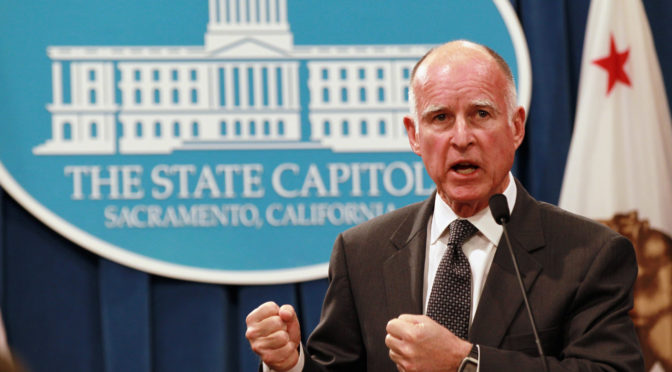
Gov. Jerry Brown signed off on a variety of bills in September that aim to protect patients and health care consumers.

The following laws are set to go into effect in 2017.

AB 72: “Surprise medical bill” legislation by Assemblyman Rob Bonta (D-Oakland) was among the most-talked-about measures of the year in Sacramento. It promises to better protect consumers against unexpected medical bills.

Patients can receive such bills when they use a hospital or clinic considered in-network by their insurance plan but are treated by a provider who does not contract with the insurer such as radiologists, anesthesiologists and pathologists. With the goal of keeping patients out of the fight between providers and insurers, the new law essentially sets a reimbursement rate requiring insurers to pay out-of-network doctors 125 percent of the amount Medicare pays for the service or the insurer’s average contracted rate, whichever is greater.

“With his signature, Governor Brown has enacted some of the strongest patient protections in the nation against surprise medical bills. This issue has been debated but has gone unresolved for decades,” Bonta said in a statement.

SB 482: Amid a national opioid epidemic, Brown approved legislation that requires doctors to check a patient’s prescription history in a state database before prescribing any potentially addictive drugs.

The bill, by Sen. Ricardo Lara (D-Bell Gardens), calls for doctors to consult California’s prescription drug monitoring database when prescribing controlled substances. Failure to do so under the new law could result in disciplinary action, although there is no way to ensure that doctors actually use this tool before prescribing.

The new law is meant to put a stop to “doctor shopping” — the practice of visiting multiple doctors to obtain prescription for opioids.

SB 586: The legislation, a compromise between the Department of Health Care Services and children’s advocates, aims to slow down and improve plans to overhaul the way the state’s most medically fragile children receive care.

Currently, severely ill children with conditions like cancer or cerebral palsy receive care through an 89-year-old state program known as California Children’s Services. The Department of Health Care Services announced its plan last year to move these children into Medi-Cal managed care plans to streamline their care. Parents and child advocates argued that the transition was too quick and poorly planned, and could interrupt care for these children. The bill adds changes demanded by parents and advocates to improve case management and coordination for children affected by the transition.

The bill, introduced by the head of the state’s Senate Health Committee, Sen. Ed Hernandez (D-West Covina), allows DHCS to implement the transition to 21 counties by July 2017. The remaining counties will follow. The full transition of the state’s 190,000 children should be complete by 2022.

Ann-Louise Kuhns, president and CEO of the California Children’s Hospital Association, said the new law “both protects the high quality of care assured by the California Children’s Service program and promotes a careful, phased integration with managed care.”

SB 908: This bill will allow consumers to learn when their health insurance premium rates have been considered “unreasonable” by state officials. Current law requires that unreasonable rate hikes be posted online by one of the two state agencies that regulate insurers — the Department of Managed Health Care or the California Department of Insurance. But consumers don’t check online, the bill’s supporters argued.

The new law will require insurers to notify individuals and small businesses directly in writing — at least 60 days before the rate changes — so that consumers can shop around if they choose.

“This law will discourage unjustified health plan rate hikes and empower consumers to make informed decisions about the coverage they are choosing,” said Anthony Wright, executive director of Health Access California, a Sacramento-based consumer advocacy group.

SB 1076: This law, sponsored by the California Nurses Association, was designed to protect hospital patients in “observation” care. It requires that observation units meet the same staffing standards — nurse-to-patient ratios — as those in the emergency room.

Outpatient services are not covered by the same patient protection regulations as inpatient units, and many times patients are left in an observations status for a long period of time, according to supporters of the law. In addition, such treatment is not counted toward the three days of hospitalization that Medicare requires for a patient to be covered for nursing home care once they are discharged from the hospital.

The new law will also require that hospitals report summaries of the care they provide during observation status to the Office of Statewide Health Planning and Development for data collection.

Sourced From  – http://californiahealthline.org/news/california-governor-signs-flurry-of-health-laws/
Hillary is Disqualified from Holding Any Federal Office – Based On The Law

We’re so used to complicated problems that we occasionally overlook the obvious.  Like fiddling around with some gadget, trying to get it to work when all you needed to do is plug it in.

Could the solution to the “problem” of Hillary running for president be just that simple?  Did she really break the law — and would the penalty for breaking that law disqualify her from being president?  The answers to those two questions are “yes,” and “yes.”

If someone were to ask you if there is a law that Hillary has broken that should end her campaign for president right now, you’d probably answer that the laws broken by Hillary are innumerable.  But could you mention a specific law?  Well, now you can, and it was hidden in plain sight. If we laypersons can figure it out, it sort of makes you wonder what the FBI was doing when investigating Hillary’s email server.

Apparently, the FBI forgot to visit the Cornell Law Library. Word for word from the Cornell Law Library Former United States Attorney General Michael Mukasey tells MSNBC that not only is Hillary Clinton’s private email server illegal, it “disqualifies” her from holding any federal office. Very specifically points to one federal law, Title 18. Section 2071.

So here’s the one law you need to know that should terminate her presidential campaign:

For those of us who do not have United States Code committed to memory, here’s what it says:”(a) Whoever willfully and unlawfully conceals, removes, mutilates, obliterates, or destroys, or attempts to do so, or, with intent to do so takes and carries away any record, proceeding, map, book, paper, document, or other thing, filed or deposited with any clerk or officer of any court of the United States, or in any public office, or with any judicial or public officer of the United States, shall be fined under this title or imprisoned not more than three years, or both. (b) Whoever, having the custody of any such record, proceeding, map, book, document, paper, or other thing, willfully and unlawfully conceals, removes, mutilates, obliterates, falsifies, or destroys the same, shall be fined under this title or imprisoned not more than three years, or both; and shall forfeit his office and be disqualified from holding any office under the United States. As used in this subsection, the term “office” does not include the office held by any person as a retired officer of the Armed Forces of the United States.”

Yes, it explicitly states “shall forfeit his office and be disqualified from holding any office under the United States.”

So, yes, it really is that simple.  Hillary is “disqualified from holding any office under the United States.”  So the only question left really should be, who is going to replace her on the Democrat ticket?

How a Mexican drug cartel banked its cash in NYC

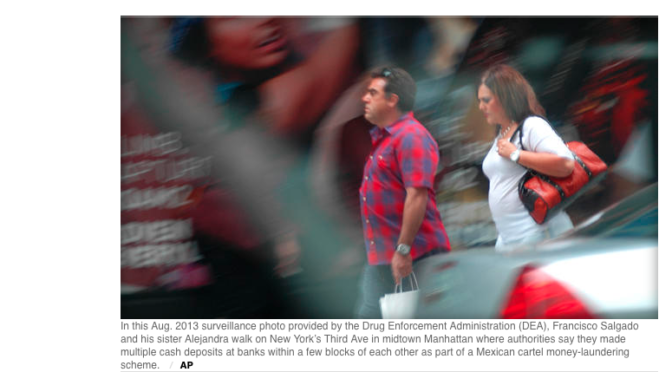
NEW YORK — In the photos, Alejandra Salgado and her little brother Francisco look like ordinary tourists strolling the streets of midtown Manhattan. He carries a shopping bag. She wears a white dress, a necklace and a leather tote slung over one shoulder.

But the outings were hardly innocent.

Over two hours, federal agents snapped pictures as the pair visited seven banks, stopping at each one to make cash deposits of just under $10,000 — all from piles of drug money stashed in their bags.

Prosecutors say the flurry of modest deposits was one of the many schemes hatched by Mexican crime cartels trying to bring billions of dollars in drug proceeds back from the United States without attracting scrutiny from banking regulators.

The cartels collect much of their cash proceeds from the U.S. market much the way the cocaine and other drugs come in, by sneaking it across the border.

But using regular banks remains in the mix, said James Hunt, head of the Drug Enforcement Administration’s New York City office. The trick is keeping deposits small, because banks are required to report cash deposits of $10,000 or more to the government. The benefit, he said, is that if investigators do catch onto such a scheme, less cash gets confiscated. The bagmen also often face less jail time.

“It’s a little more time-intensive but it’s not as heavy a hit if you get caught,” Hunt said.

Before they went to prison late last month, the Salgados were paid to launder up to $1 million a month collected from drug wholesalers doing business with the notorious Sinaloa cartel, prosecutors said.

Investigators say Alejandra Salgado, 59, who has a Mexico City address and was in the U.S. on an expired visa, was supervised by a high-ranking member of the cartel.

Agents began watching her in New York after her name came up in an investigation of money-laundering cells in southern California, Michigan and Arizona being conducted by investigators from the DEA Drug Enforcement Task Force, Department of Homeland Security, the IRS and local agencies.

Details from the case files of federal agents and narcotics prosecutors provided to the AP offer a look inside how the Salgados operated.

At one point she had been a courier who would drive drug money over the border.

But later, she was assigned by cartel leaders to deposit funds into multiple bank accounts held under fake names, then write checks to a produce company in San Diego controlled by the cartel.

An undercover investigator wearing a wire recorded her calling the assignment a “hassle,” but safer than her previous gig.

After her handler told her there was “a lot of work” for her in New York, she and her brother, a legal resident with an Alaska address, set up shop at a Manhattan hotel in the summer of 2013.

She preferred to collect payments from local drug dealers in midtown, rather than in their home territories in the Bronx or Washington Heights, for security reasons.

“Like a friend of mine said: ‘This is a business for tough people,’” she said in a conversation with the undercover agent. “And it’s all based in trust.”

While under investigation, the siblings made at least two dozen deposits in amounts ranging from about $8,100 to $9,600 at banks located from the Upper West Side to Canal Street.

Following the money trail was worthwhile to “gain insight into the practices” of the cartels, said Special Narcotics Prosecutor Bridget G. Brennan, whose office prosecuted the case.

Sourced From  – http://www.cbsnews.com/news/how-a-mexican-drug-cartel-banked-its-cash-in-nyc/

EU Police Agency: 314 Arrested in Organized Crime Raids

  • By MIKE CORDER, ASSOCIATED PRESS

THE HAGUE, Netherlands — Oct 19, 2016, 8:40 AM

Police and other law enforcement organizations around the world cooperated in a massive weeklong operation targeting organized crime that led to 314 arrests, the seizure or 2.4 tons of cocaine and interception of hundreds of migrants, European Union police agency Europol announced Wednesday.

Law enforcement teams in 52 countries, supported by organizations including Interpol and EU border agency Frontex, took part in the series of interlinked raids and investigations that also focused on cybercrime and airline ticket fraud.

“The results are pretty impressive, I think, in terms of the number of arrests,” Europol Director Rob Wainwright told The Associated Press in a telephone interview. “I’m especially happy with the impact on trafficking human beings and the number of potential victims that we identified.”

Europol said the operation intercepted 745 migrants and identified 529 victims of human trafficking.

Wainwright said that the multi-agency operation involving nations around the world is an effective way of tackling modern organized crime networks.

“Crime is becoming more cross-border and criminal networks are becoming more agile at operating in different criminal markets simultaneously,” he said.

Another focus was airline fraud and police detained 193 people suspected of traveling using tickets bought with stolen or fake credit cards.

Such fraud costs the aviation industry an estimated $1 billion a year, Europol said. Wainwright said that there are vital security implications, too.

“We cannot allow anyone, in particular serious criminals and terrorists, to travel around the world anonymously and to endanger others,” he said in a statement.

Among other raids, Greek police discovered a fake travel agency that was facilitating migrant smuggling and trafficking in human beings, while in Austria police raiding a brothel also discovered a cannabis plantation, triggering a new investigation.

Sourced From – http://abcnews.go.com/International/wireStory/eu-police-agency-314-arrested-organized-crime-raids-42900532